A film document of the history of Mexico, presented in four novellas: Sandunga, an exposition of Tehuantepec jungles and the peaceful lifestyles of their inhabitants; Manguei, a love story about a poor peon and his bride; Fiesta, devoted to bullfighting and romantic love; and Soldadera, a portrayal of the 1910 revolution in Mexico as depicted in the frescoes of Siqueiros, Rivera, and Orosco. Previously issued in less complete version under title: Thunder over Mexico. Reconstructed by Grigori Aleksandrov in 1979 from materials directed by Sergei Einstein in 1931.
Source : www.lib.berkeley.edu/
An unfinished film, for which more than 50,000 metres of negative were shot.
On 24 November 1930, Eisenstein signed an agreement for the production of the film with Mary Craig Sinclair, wife of the novelist Upton Sinclair. Other anonymous backers were to contribute to the financing of the film, but the filmmakers — Eisenstein, Alexandrov and Tissé — were to receive no salary. They worked throughout 1931. On 24 January 1932, while they were still hoping to shoot Soldadera, production was halted on Upton Sinclair’s orders.
Eisenstein was able to view in New York the rushes of his film, which had been developed in Hollywood, and then left the United States in April 1932. It had been planned that a positive print would be sent to him in Moscow so that he could edit the film there, but the investors reversed their decision and the material ultimately remained in the United States. According to some sources, notably Barthélemy Amengual, the film material intended for Moscow was intercepted in Hamburg on Sinclair’s orders and sent back to the United States.
The four films listed below were edited using material from his unfinished work, but Eisenstein took no part in them.
In Kino: A History of the Russian and Soviet Film, Jay Leyda describes Eisenstein’s despair at having been deprived of his work and the indignation aroused in screenwriter Vsevolod Vishnevsky by what he regarded as the Americans’ sabotage of the master’s work. In June 1939, in an essay paying tribute to Eisenstein, V. Vishnevsky wrote: “The wreckers who were then running the film industry played a disgusting trick on Eisenstein. He was dismissed from his work (on Que Viva Mexico!) just before beginning the editing, and the film was lost to the Soviet Union. Others, in America, edited his work; the negative was ground to powder.” (p. 417).
Que viva Mexico! (Да здравствует Мексика!), edited by Grigori Alexandrov in 1979
Using the footage shot in Mexico that eventually returned to the USSR, Grigori Alexandrov was able to edit a version of the film, released in 1979 and probably the closest to the original project.
USSR, 1979, 89 minutes
Direction: Grigori Alexandrov and Nikita Orlov. Screenplay: Grigori Alexandrov. Cinematography: Eduard Tissé, Nikolai Olonovsky. Editing: Esfir Tobak. consultant: Dr Rostislav Yurenev, art-history consultant. Commentary: S. Bondarchuk. Production: Mosfilm.
Black and white, 9 reels, 2,437 metres.
Synopsis:
Grigori Alexandrov appears on screen and, using photographs, explains the circumstances in which the film was shot in Mexico in 1931 and 1932. We see photographs of the three filmmakers — Eisenstein, Alexandrov and Tissé — during the Mexican expedition: thousands of kilometres travelled with the assistance or advice of the artists Diego Rivera, David Siqueiros and José Clemente Orozco. He explains his present role in making the film: once the footage had finally been returned, he decided to edit the rushes from the screenplay written by Eisenstein. He adds that “no one knows how the master would have edited it,” but that from this extraordinary country with its tragic history Eisenstein wanted to create “a richly coloured symphony…” The text of the screenplay is spoken by Bondarchuk.
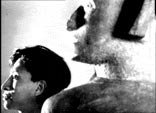
Prologue. It is the time of eternity… “perhaps twenty-five years ago… a thousand years ago…” Close-ups of the carved stones of the pyramids: heads of gods, heads of men? Profiles of contemporary faces are juxtaposed with the sculptures, emphasizing their resemblance to the faces in stone. The living heads then bend over a coffin in which a young Mexican lies: the same face with its pure features… an immutable portrait across time, and an unchanging severity in the face of inevitable death. Carried by men, the coffin passes through fields of cacti under the gaze of impassive women. Dazzling light and deep shadows fall across the procession. Then, among the foliage, a young girl brushes her hair: “The world seems to be in its earliest age, filled with this princely indolence.”
I — Sandunga. This is the song “of young girls’ dreams.” Concepcion adorns herself with a necklace of orchids: it foreshadows the gold necklace, the passport to marriage for the girls of Tehuantepec. She travels by canoe to join her lover, who is swaying in a large white hammock. The voice-over describes the customs of this people: “matriarchy.” It is the women who work. We see them at the market, dreaming, carrying fruit on their heads in large trays. Then comes the wedding of Concepcion and Abundio: the gold necklace seals their union; young girls in long white dresses celebrate the event. We see the dance, to the voluptuous rhythm of the sandunga. Finally comes the ceremony: an immense procession involving the entire village; the church, the bells, preparations for the feast, the palm branches carried by the young girls, their dance in front of the bridal home. “Life flows slowly. The centuries have not changed the customs.” Children are born.
II — Fiesta. This is the festival in honour of Our Lady of Guadalupe, associated with the evocation of Cortés’s conquest of Mexico. Masks of predators parade past, helmeted, with fixed and cruel expressions. They are followed by the white and lugubrious masks of Spanish monks. Then come three present-day monks, dark and ominous, their silhouettes outlined against the sky. We then witness the young people’s Way of the Cross: dressed in white, they climb on their knees, for hours, the steps of the Aztec pyramid on top of which a cathedral has been built. Among them, three men dressed in black, standing upright with cactus stalks tied to their shoulders, make the pilgrimage. At the top of the mountain, priests bless the procession. The three crucified pilgrims raise desperate eyes towards the empty sky. The religious ceremony is followed by a dance of death. Finally comes the bullfight, in honour of the Virgin of Guadalupe. David Liceaga, the matador, prepares himself, visits his mother (a final farewell?), kneels before the statue of the Madonna, and then enters the arena. Before the eyes of the enthusiastic crowd, man and bull confront one another. Then evening restores peace during a boat trip. “Mexico is tenderly lyrical, but cruel too,” says the narrator. We see the gaunt, wretched figures of the peons waiting and praying along the walls of a hacienda; suddenly they begin to move and set off towards the maguey fields.
III — Maguey. It is the beginning of the twentieth century, under the dictatorship of Porfirio Díaz, in the state of Hidalgo. In the scorching heat, the peons cut the cactus leaves and then draw the sap from the plant into gourds. A liquor will be made from this milky sap. A strange and humble procession appears: the father on his donkey, the mother and daughter on foot. The daughter, Maria, is being brought by her parents to Sebastián, her future husband. The young couple return to the hacienda. The landowners, replete, are drinking, and Maria is presented to them: such is the custom. A drunken guest rapes her. Sebastián seeks revenge and attacks the estate. With his brother, he flees reprisals into the maguey fields. Tragedy follows: pursued by the owner’s daughter and her fiancé, they fire at random. The young woman is killed. The punishment is merciless. Caught with lassos, Sebastián and his friends are buried alive up to their necks, and galloping horses trample the young men’s faces as their eyes turn desperately towards the sky. In the morning, Maria’s path takes her to the place where Sebastián was put to death. She raises her eyes towards the sky. Without transition, images of rebellion appear.
IV — Soldadera. The filmmaker Alexandrov reappears on screen. He explains that enslaved Mexico now gives way to Mexico in revolution. But the sequence could not be filmed for lack of money. The film would have shown the uprising of 1910 and paid tribute to the women soldiers who took part in the struggle, the soldaderas. They are the symbol of Mexico, says the director.
Epilogue. 1931: contemporary Mexico. The Day of the Dead, 2 November. This sequence is dominated by images of skulls. The entire population, from children to old people, wears skull masks. It is an immense carnival in which death is mocked by masked men performing obscene dances. Feasts take place in the cemetery. The voice-over comments: “Mexico despises death, and it laughs at death.” Chocolate coffins are sold and eaten by children. The sequence ends with a close-up: a child removes his skull mask: “He is a son of the soldadera.”
Other films using footage from Eisenstein’s shoot:
Thunder over Mexico / Tonnerre sur le Mexique — USA, 1933; 72 minutes.
Editing: W. Donn Hayes and Carl Himm. Music: Hugo Riesenfeld. Production: Sol Lesser.
Most of the material in this film was taken from Maguey. Around 1900, on a hacienda, a young peon whose fiancée has been raped rebels and takes to the hills. He and three companions are buried up to the waist and then trampled by horses.
Jay Leyda, then a film student in Moscow, observed of this editing of the Que Viva Mexico! rushes: “Eisenstein was almost utterly in despair when it became known in Moscow that, ‘in order to recover his investment,’ Upton Sinclair had sold the footage shot in Mexico to a Hollywood company for editing and exploitation. What was such a terrible blow to the director was not the fact that Thunder over Mexico was being presented as Eisenstein’s film, but the thought that his negative had been irreparably ruined.” (op. cit., p. 347)
Kermesse funèbre — USA, 1933
Production: Sol Lesser.
Short film: approximately 400 m.
Dazzling images contrasted with a questionable commentary and musical score.
Time in the Sun — USA, 1940, 55 minutes
Editing: Marie Seton.
Sound compilation.
A respectful tribute by an admirer of Eisenstein: beautiful images rather than a film.
Eisenstein’s Mexican Film: Episodes for Study — USA, 1957, approximately 230 minutes
Direction / editing: Jay Leyda, using footage shot by Sergei Eisenstein and Eduard Tissé.
A former student of Eisenstein, Jay Leyda did not attempt to reconstruct the editing his master might have created. He presented the rushes in an effort to respect the reconstructed order in which they had been shot by Eduard Tissé, so that the original material could be studied without imposing a new narrative structure upon it.